-01-1.png?width=1200&height=238&name=Logo%20-%20Social%20(V001)-01-1.png)
 ·
7 minute read
·
7 minute read
A borrower in Frisco just asked ChatGPT who to use for a mortgage. Your loan officer didn't come up.
Not because they're bad. They've got 214 five-star reviews.
Every one of them is sitting on a review vendor's page, under the vendor's logo, and the newest one is from March.
That's the problem with how the whole industry does reviews.
Collect. File. Repeat.
The survey goes out on the vendor's schedule, in the vendor's template. Borrower leaves five stars. It lands on a page you don't own, the vendor's domain gets the traffic, you get the invoice, and the review never does another thing for you.
Do the math on your shop. 600 producers, eight closings a month, that's somewhere around 4,000 five-star reviews a year.
Now ask your marketing team how many of them anyone saw.
Not "how many came in." How many got seen by a realtor, a past client, a borrower deciding who to call.
If the answer is "they're on the review page," you're paying full price for half a product.
Jump to:
Why Collecting Isn't Enough | What Happens After the Review | The Questions Everyone Asks First | A Referral Waiting to Be Delivered | Key Takeaways | FAQs
Why Collecting Mortgage Reviews Isn't Enough Anymore
Two things changed while most of us were busy collecting.
The first is where borrowers start. Adobe's 2026 AI and Digital Trends research found that about a quarter of consumers now name AI platforms like ChatGPT as their top research tool, ahead of brand websites and online reviews.
That's consumers broadly, not mortgage borrowers specifically, but I'd be surprised if home buyers were the exception. That doesn't make reviews less important. It changes their job.
A review used to be something a borrower went looking for and read.
Now it's increasingly one of the signals that shapes the answer before the borrower visits any website at all. (We've written about how loan officers can show up in AI search results if you want the practical side of that.)
The second change is freshness. Google says review count and rating factor into local search ranking, and most local SEO practitioners will tell you recent reviews carry more weight than old ones.
Borrowers notice dates too, algorithm or not. A pile of reviews from 2023 reads like a pile of reviews from 2023.
So collecting is only the first half of the job. Mortgage reputation management today means getting every review in front of the people who matter while it's still fresh, and keeping new ones coming in.
That's what we built Reputation Management inside SocialCoach to do.
What Happens After the Review: How Reputation Management Puts Loan Officer Reviews to Work
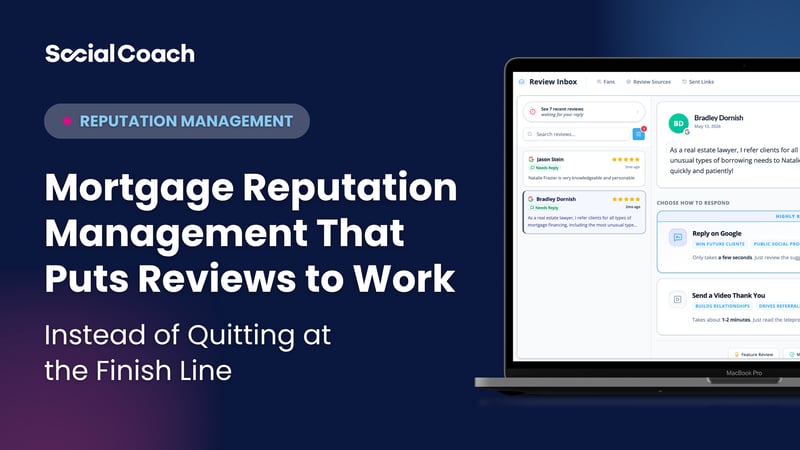
Reputation Management handles the standard pieces: surveys, review requests, first-party reviews, and routing to Google, Facebook, and Zillow.
If you have a review vendor today, you have some version of that already, and I'm not going to pretend it's revolutionary.
But we kept meeting lenders with great review programs...whose loan officers' feeds showed almost none of it.
The reviews were sitting in one system, and the LO's social presence was sitting in another.
So here's what we built that your current review platform doesn't have:
1) Every Review Becomes a Branded Post on the Loan Officer's Own Social Accounts
When a borrower leaves a review, SocialCoach turns it into a post using your templates and branding. Then it publishes that post to the loan officer's own social accounts.
Not the company page that 40 people follow. The LO's feed, where their realtors and past clients actually are. Nobody on your team designs anything. It happens for every producer whether they're a social person or not, which is most of them.
Because reviews live in the same platform as the rest of the LO's content, the review shows up in the same feed as their videos and market updates, rather than as a separate stream nobody sees. Nobody on your team designs anything. Plus, it works for every producer – not just the handful who already love social media.
At 4,000 reviews a year, that's roughly 4,000 pieces of borrower proof moving through your roster's feeds, with zero hours of marketing time spent on them.
2) You Decide When to Ask for Reviews, Not Us
You can ask at pre-approval, clear to close, funding, 30 days after closing, or ask the Realtor on the deal. You can build different flows for purchase and refi if you want them, and as many as you want.
I've sat through a lot of vendor "best practices" decks and here's what I've figured out: best practices is what a vendor sells you when their tool only does one thing. You know your borrowers. Run your play.
3) Review Requests and Responses Can Be Sent by Video
The ask doesn't have to be a form. A loan officer can send the request as a 30-second personal video and respond to reviews by video too.
Think about the last survey email you got from a company you'd done business with. Did you fill it out? Now picture a short video from the person who just got you into your house, asking how it went. I know which one I'd answer.
4) Review Content Follows the Same Compliance Rules as Everything Else
Review requests, responses, and the posts they generate all go through the same approval queue you already use for everything else your producers put out.
Borrowers don't write reviews with your compliance policy in mind. Some mention rates. Some describe promises your loan officer would never put in writing. Once your LO publishes that review as a post, it's their marketing, and it deserves the same scrutiny as anything else they put out.
In SocialCoach, review requests, responses, and review-generated posts all run through the same point-of-creation compliance rules your team already uses for social and video. There's no second login for your compliance team. No new policy.
Quick question if you've got a standalone review tool today: who's checking the review posts before they go out under your logo? Usually nobody.
Switching Review Platforms: The Questions Mortgage Marketing Leaders Ask First
"We'd lose our reviews." We import them. Counts and ratings come over, so nobody starts at zero, which means nobody gets to use that as an excuse not to switch over.
"But their profile pages rank on Google." Some do, and it's worth thinking about why. Every review your producers earn is feeding a vendor's domain instead of yours. Reputation Management publishes reviews to your own website, where your domain authority is, so the traffic and the search credit land on you. Every LO landing page gets a live review widget that updates automatically as new reviews come in. Your producers' reviews should be building your site's authority, not somebody else's.
"We already pay four vendors." That's what SocialCoach is trying to solve. Social, video, compliance, and reviews all touch the same LO and the same borrower, usually through four contracts, four logins, and four sets of reports. Reputation Management puts reviews in the same platform, with reporting that rolls up by LO, branch, region, and company like everything else in SocialCoach.
We launched with more than 130,000 reviews already in the platform, and it's live at Rate, one of the largest retail mortgage lenders in the country. This isn't a beta – it's a fully-built system.
A Review Is a Referral That Hasn't Been Delivered Yet
Referrals don't come from reviews. They come from people seeing reviews.
I think that's the step our industry quietly skipped. We spent years getting good at asking and never got especially good at delivering.
A five-star review sitting on a profile page is proof that exists. The same review showing up in a loan officer's feed the week it was written, in front of the Realtor who sent the deal and the past client who might send the next one, is proof that somebody actually sees.
Those reviews, showing up in 600 LO feeds every week, are the most consistent brand campaign your company will ever run.
And every month you sit on this decision, that's another few hundred five-star reviews growing stale that won't do a thing for you.
Your loan officers already earned the reviews. Give them a job.
See how Reputation Management works →
Key Takeaways
- Most mortgage review programs measure collection, not exposure. The number that matters is how many reviews Realtors, past clients, and borrowers actually saw.
- AI search is changing what reviews do. About a quarter of consumers now name AI tools as their top research source, so reviews increasingly shape the answer before anyone visits a website.
- Fresh reviews matter more than old ones. Review count and rating factor into local search, and borrowers notice dates.
- Reviews are most valuable on the loan officer's own feed, next to the rest of their content, where referral partners and past clients already pay attention.
- Review-generated posts are marketing. They should follow the same compliance rules as the rest of a loan officer's social content.
Frequently Asked Questions About Mortgage Reputation Management
What is mortgage reputation management?
Mortgage reputation management is the process of collecting, monitoring, responding to, and distributing borrower reviews for a lender and its loan officers. Beyond generating reviews, an effective program makes sure they're seen, on review sites, on the lender's website, and on each loan officer's social accounts, while staying within the lender's compliance policies.
What is SocialCoach Reputation Management?
Reputation Management is a review and survey tool built into the SocialCoach platform for mortgage lenders, banks, credit unions, and brokerages. It collects first-party reviews, routes reviews to Google, Facebook, and Zillow, and automatically turns each review into branded social content published to the individual loan officer's accounts.
How is it different from a standalone review platform?
Reviews live in the same platform as each loan officer's social content, video, and compliance controls. Review posts appear alongside the rest of the LO's content and follow the same compliance rules. Review requests and responses can be sent as personal video. Lenders set their own survey timing at each loan milestone.
Can we bring over existing reviews from another platform?
Yes. SocialCoach imports existing reviews so loan officer review counts and ratings carry over on day one.
Can loan officers ask for reviews by video?
Yes. Review requests and review responses can be sent as MVP videos from the loan officer inside SocialCoach.
How do review-generated posts stay compliant?
Review requests, responses, and review-generated social posts go through the same point-of-creation compliance controls as every other post and video a producer publishes in SocialCoach.
Where do the reviews show up?
On the lender's own website and on each loan officer's landing page, through a live review widget that updates automatically. They're also routed to Google, Facebook, and Zillow and published to the loan officer's social accounts.
Who is Reputation Management for?
Enterprise mortgage lenders, banks, credit unions, and brokerages. It's available to any lender, not only existing SocialCoach clients.
📚 Related Reading
- How Mortgage Loan Officers and Real Estate Agents Can Show Up in AI Search Results
- Mortgage Social Selling Strategy: Growth Belongs to the Deepest Bench
- Why AI Is Breaking Your Mortgage Compliance System (And What It Costs You)
- Meet MVP: Your Team's Favorite New Follow-Up Tool
- 10 Mortgage Marketing Lessons Industry Leaders Are Taking Into 2027
.png)