-01-1.png?width=1200&height=238&name=Logo%20-%20Social%20(V001)-01-1.png)
 ·
9 minute read
·
9 minute read

A few days ago Jill Johnson, who runs in the marketing compliance world and, as her LinkedIn says, is "Compliant, But Funny," sent me a question from her new compliance roundtable.
Her question, more or less:
How are companies actually using AI in marketing, and how are they keeping it compliant?
What about copyright and hallucinations, and who is checking any of it when a content creator uses AI? And have regulators started to get involved?
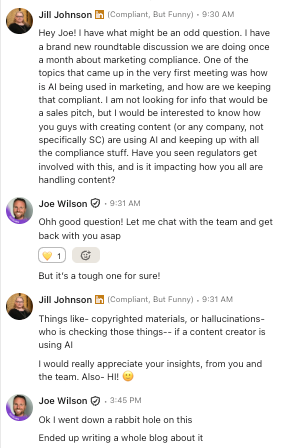
Here ya go, Jill ;)
I went down a rabbit hole on this one, and it turned into a whole blog. Here is what I found. AI is not creating a new mortgage compliance problem. It is scaling the one you already have. And the review queue most companies rely on is the first thing it breaks.
Jump to:
How One Approved Post Becomes 200 Violations | The Scale Problem | Why Manual Video Compliance Is Impossible | Compliance Rules Haven't Changed, But the Enforcement Has | The Solution: Point-of-Creation Compliance | The Four-Lane Model for AI Content | The Future of Mortgage Marketing | The 4 Questions Every Mortgage Leader Asks About AI and Compliance, Answered | Mortgage Compliance + AI FAQs
How One Approved Post Becomes 200 Violations: The AI Personalization Problem
Personalization is good because it makes social content feel human. The trouble starts when personalization changes the claim.
Marketing approves this:
Have questions about the homebuying process? I am happy to help you understand where to start.
A loan officer asks AI to make it stronger. AI returns this:
I guarantee I can get you approved fast and lock in the best rate in town.
Three flags in one sentence. A guaranteed approval, which Regulation N treats as a misrepresentation of the borrower's likelihood of getting a loan. A speed promise. And a "best rate" superlative no company can back up.
The same thing happens with a refinance.
Approved version:
A refinance conversation starts with understanding your current loan, goals, and timeline.
AI rewrite:
Refinance with me and I'll help you save thousands, with a payment under $1,800 a month at the lowest rate anywhere.
An inferred guarantee, "save thousands," a specific payment that triggers disclosures under Regulation Z, and another superlative.
Whether any of it is true depends on the borrower, the loan, and the math.
This isn't AI hallucinating – it did what it was told. "Make it stronger." And in doing so, it walked straight past the line.
The Scale Problem: How a 200-LO Team Becomes a Compliance Nightmare With AI
Run this across a 200 loan officer team:
-
Marketing builds one approved campaign
-
Every producer personalizes it with AI
-
You no longer have one approved post. You have 200 different ones, and none of them are being reviewed before they actually get published.
It gets worse.
Open LinkedIn right now and you'll find an influencer promising loan officers that AI can build their entire marketing calendar in one sitting. 90 days of posts in 30 seconds. 60 days while you sleep. A full quarter of content before the coffee is cold.
It's a great hook...but it's also a compliance time bomb.
How much of a quarter's worth of auto generated mortgage content is actually compliant? Who is double checking it for accuracy or compliance?
Nobody. The content goes out faster than any human could read it.
And there's the second problem hiding under the first:
When every loan officer feeds the same tool the same prompt, they all get the same content.
The same hooks, the same captions, the same three takes on this week's rate news.
The thing that was supposed to make your producers stand out turns them into carbon copies of each other, and of every competitor running the same play.
You take on all of the compliance risk and get none of the differentiation.
It's getting out of hand. Fast.
Why Video Compliance Is Impossible to Handle Manually (And What to Do About It)
Video is where every loan officer is being told to go, and they are right to go there.
In 2026, 91% of businesses use video as a marketing tool, short form video is the highest ROI content format there is, and most people would rather watch a short video than read about something.
Video is not a nice to have. It's the main channel for growth. But it's also the hardest content to keep compliant.
A loan officer can promise a guaranteed approval at the 0:47 mark of a three minute video, and that spoken claim carries the same legal weight as if it were printed on a billboard.
And the math for reviewing that content feels staggering. If each of your 200 producers posts just two videos a week (none longer than 90 seconds), that's 400 videos – and adds up to 10 hours of footage every single week, just to watch each one through once.
But nobody reviews videos in one watch.
You replay the parts you aren't sure about, or flag the questionable ones and watch them again. Then you chase down each loan officer to explain what crossed the line and what to fix.
Add it up and that 10 hours of watching becomes a full time job, one person doing nothing but reviewing video, every week, forever. And that's not even counting the video messages sent straight to borrowers by text, email, or DM that compliance never even sees.
No team can keep up with that. It's not just hard, it's impossible.
So companies do one of two things:
-
Let video go out unreviewed and hope for the best.
-
Quietly discourage video and ignore the format that drives the most business.
Both lose.
Mortgage Compliance Rules Haven't Changed, But the Enforcement Has (State AGs Are Coming)
Everyone is hunting for "the AI rule." The existing rules already cover this, and they bite harder now.
-
Regulation N makes you keep every materially different mortgage ad, including scripts and social posts, for 24 months, and failing to keep those records is its own violation.
-
The CFPB moved to reinstate that requirement in early 2026. If you cannot produce the version that actually went live, you do not have control.
-
Regulation Z forces disclosures the moment an ad states a payment, a down payment, or a rate. That is why "3% down," "save thousands," and "$1,800 a month" cannot fly on their own.
Now the part that lulls people to sleep. Under the Trump administration, federal regulators have pulled back hard. The CFPB has been gutted, fair lending standards were narrowed, and a March 2026 executive order told agencies to lighten the mortgage compliance load.
If you only watch Washington, it looks like the heat is off.
It's not. This is temporary, the way everything in politics is temporary. The pendulum always swings back, and the records you create today live for years.
More importantly, the enforcement did not disappear. It changed.
As the feds stepped back, state attorneys general stepped up, regulating consumer finance more aggressively in 2025 than ever before to fill the gap. States are hiring former CFPB staff, writing new AI advertising rules, and using their own authority to chase deceptive marketing.
New York is leading on AI disclosure. Texas's new AI law carries penalties up to $200,000 per violation.
Fewer federal eyes. More total eyes, and more of them local.
Why a Bigger Compliance Team Won't Solve Your AI Problem
The common answer is to review more.
Scan what gets posted, get alerted when something looks wrong. Discover, monitor, alert.
It's too late by design.
The second a post is live, it can be captured and shared.
You can delete the post, but you can't delete the screenshots that live on in borrower photo libraries and email history.
A tool that flags a violation after it's public isn't preventing risk – it's documenting it.
That's the difference between reactive and proactive. Reactive finds the problem after the consumer has already seen it. Proactive stops it before the consumer ever does.
Only one of those protects you.
The Solution: Point-of-Creation Compliance That Stops Violations Before They're Public
Think of bumpers on a bowling lane. They don't stop the game – they let more people play.
Point-of-creation compliance checks content the moment it's made, before it's ever public.
That's how SocialCoach works, regardless of whether marketing is building content for the whole team or a loan officer is creating their own.
First, your company sets the rules. You decide which words and phrases are flagged for additional review after posting and which are blocked before being allowed to go live in the first place. Your interpretation of the regulations are set once, applied to everyone.
Then every post gets filtered on the way out, across the three places risk hides:
- The caption text, scanned against your rules
- The image, which gets OCR scraped so text is caught whether it's a designed graphic or a photo of handwriting on a whiteboard
- The video, transcribed so what a producer says is held to the same standard as what they type
That third one is the part no human team can match. SocialCoach transcribes every video and surfaces the exact moment a flagged phrase appears, with a timestamp, once it posts or sends.
The hardest thing to police by hand becomes the easiest thing to check.
From there it's simple.
Content that uses blocked words doesn't get published, and the producer is told why on the spot, which teaches the boundary.
Flagged content routes to compliance, which means your team can stop trying to monitor everything and reviews only the exceptions.
The bottleneck disappears.
The Four-Lane Model for AI Content
Here's how to sort what AI is allowed to touch, into four lanes.
Green: AI helps freely. Low risk work that does not change the message. Shortening, clarity, turning a transcript into bullets. The rule: improve the writing, never add rates, payments, claims, or eligibility.
Yellow: AI helps inside guardrails. Where most content lives. Education, local market posts, captions, video messages. AI helps while flagged terms, disclosure checks, and fair lending filters watch. Controlled personalization.
Red: Route to review. The risky stuff. Rates, payments, down payment numbers, savings, approval and qualification language, FHA, VA, and USDA wording, testimonials. Not "never post." Just "do not wing it with AI."
Locked: AI does not touch it. Rate sheets, payment examples, official disclosures, complaint responses. Approved and archived only.
Most content lives in green and yellow. The Four-Lane Model just keeps the red and locked work from ever being treated like it belongs there.
How to Prove Your Mortgage Compliance Controls to Regulators
Everything lands in one live feed. Marketing and compliance watch posts go out in real time, open any post on the platform with a click, and pull it down or ask the producer to. Every action is captured and retained.
That is your audit answer.
When an examiner asks what controls you run, how you monitor, and how you fix problems, you show them instead of scrambling.
The question that breaks most programs, "Can you produce the exact version that went out?", becomes a search.
The Future of Mortgage Marketing: Control + Personalization (Not One or the Other)
You could build this yourself.
Content libraries, company rules, blocked and flagged terms, disclosure checks, fair lending filters, exception routing, monitoring, video transcription, and an audit trail that survives an exam.
Ten parts to assemble while volume explodes...or one system that does it at the moment of creation, before the screenshot ever happens.
Personalization without control does not scale. Control without personalization never gets used.
The future is both, and it shouldn't wait until your content is already public.
The 4 Questions Every Mortgage Leader Asks About AI and Compliance, Answered
So, Jill, you asked four things. Here are your answers, straight.
Regulators? Yes, just not where you would expect. The feds eased off, and the states stepped right into the gap. The pressure did not drop. It moved.
Copyright? Real, but mostly a policy call. Let AI rewrite your own approved material, never lift words, images, or stats from somewhere else, and keep a human on anything sourced.
Hallucinations? Also real. AI will state a wrong rate or invent a program detail with total confidence. Same fix as everything else here. Block the risky terms, route the questionable ones to a person, and keep rates and payments in locked, pre approved language.
Who's checking? The big one. It can't be a human buried under a thousand AI posts and hours of video. It has to be a system that checks every post, image, and video at the moment of creation, in your company's own words, before any of it reaches the public.
That's the whole thing. AI isn't the problem – letting it create faster than you can govern is.
Fix that, and it becomes the best thing that ever happened to your marketing.
Frequently Asked Questions (FAQ)
Is it compliant for loan officers to use AI to write their own social media posts? It can be, but only with guardrails. AI does not know your company's rules, and it will happily add rate, payment, or approval claims that violate Regulation N or trigger disclosures under Regulation Z. The safe path is to let AI help inside company set limits and check every post before it goes out, not after.
What advertising rules apply to AI-generated mortgage content? The same ones that apply to everything else. Regulation N bans misrepresenting loan terms or a borrower's likelihood of approval. Regulation Z requires disclosures when an ad states a rate, a payment, or a down payment. AI does not get an exemption. It just produces more content that has to follow those rules.
How long do we have to keep social media and video marketing content? Regulation N requires keeping every materially different mortgage ad, including scripts and social posts, for 24 months from last use. Failing to keep those records is its own violation, which is why being able to produce the exact version that went live matters so much.
How can a compliance team review AI-generated video at scale? By hand, they mostly cannot, because watching every producer's video start to finish is impossible at any real headcount. The practical answer is transcription. SocialCoach transcribes the spoken words in every video and flags the exact moment a risky phrase appears, so review takes seconds instead of hours.
What is the difference between proactive and reactive social media compliance? Reactive compliance scans content after it is public and alerts you when something is wrong, by which point the post is already live and already screenshot-able. Proactive compliance checks content at the moment of creation and stops a violation before it ever reaches a consumer. Only proactive actually prevents risk.
Can AI replace a mortgage compliance team? No. AI does the heavy lifting, scanning text, reading images, and transcribing video at scale, so the team reviews only flagged exceptions instead of everything. The judgment stays human. The volume becomes the machine's job.
Ready to Start Using Video In Your Borrower Communications?
This is what SocialCoach was built for. Producers create and send content, from social posts to one to one video messages, and every piece is checked at creation against your company's own rules. Text, images, and the spoken word in video. Blocked content never goes out. Flagged content routes to your team.
Everything is retained for the audit you hope never comes. AI lets your loan officers create more, but SocialCoach keeps your content brand-safe before it goes public.
See how SocialCoach works for enterprise mortgage teams →