-01-1.png?width=1200&height=238&name=Logo%20-%20Social%20(V001)-01-1.png)
Mortgage marketing is changing quickly.
AI can produce more content in minutes than a marketing team once created in a week.
Consumers are finding mortgage and real estate professionals through social media before they ever reach a company website.
Loan officers are being asked to build personal brands, while marketing leaders are being asked to prove revenue.
And the average mortgage marketer's job description seems to expand every time a new platform, regulation, technology, or customer expectation appears.
So we brought some of the industry's smartest mortgage marketing, sales, compliance, technology, and growth leaders together in Laguna Beach for three days to answer a bigger question:
Where is mortgage marketing headed from here?
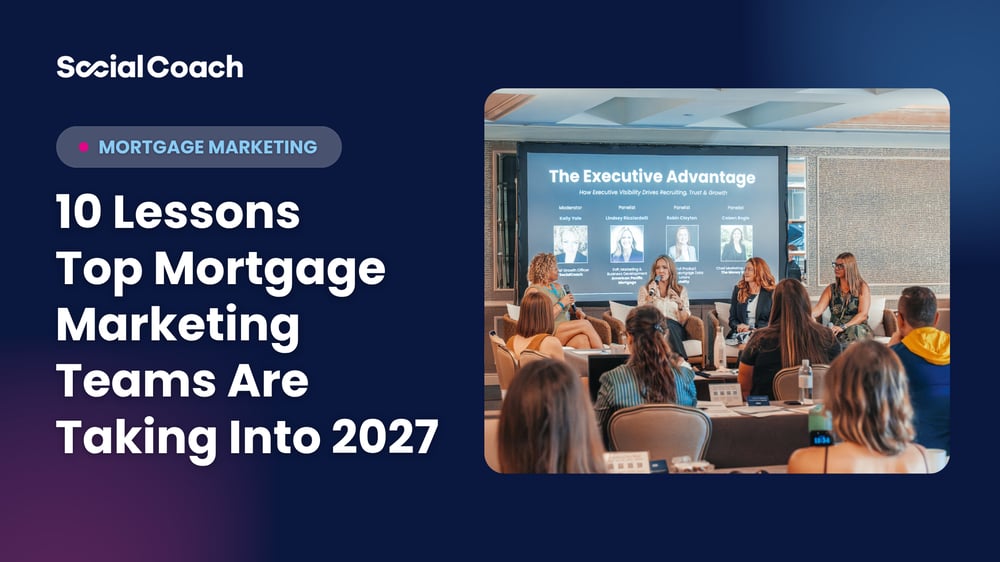
At The Mortgage Marketer 2026, leaders from across the industry shared what's working inside their organizations, where they're struggling, what they're measuring, how they're using AI, and what they believe will matter most over the next few years.
And despite covering everything from attribution to compliance to AI, a surprisingly consistent theme emerged:
The future of mortgage marketing isn't about creating more marketing. It's about building better systems for creating human connection at scale.
Here are 10 of the biggest lessons we're taking away from the conversations.
Jump to:
1) Content Ecosystems | 2) Your ROI Story | 3) The AI opportunity | 4) Adoption Solutions | 5) Trust = growth | 6) Faster compliance | 7) Employees as a marketing channel | 8) Reviews as a Referral Engine | 9) You're more than just "sales support" | 10) The future of mortgage marketing | The Biggest Lesson
1) The strongest mortgage brands are becoming content ecosystems
For years, mortgage companies approached social media the same way they approached most marketing:
Create content at the corporate level. Distribute it to the field. Keep everyone on brand.
That model solves an important problem: consistency.
But it doesn't solve the entire problem.
During our From Company Brand to Content Ecosystem panel, mortgage marketing leaders explored the changing relationship between the corporate brand and the individual brands of the people representing it.
The answer isn't choosing one over the other.
It's building an ecosystem where both make the other stronger.
Your corporate brand creates credibility, consistency, resources, education and guardrails. Your loan officers, executives, branch leaders and employees bring local knowledge, personality, relationships and lived experience.
And those individual voices matter because the way consumers discover and evaluate professionals has changed.
The conference deck highlighted that 25% of Gen Z and millennial buyers found their real estate agent on Facebook, while another 20% found them on Instagram or TikTok, according to the RE/MAX Future of Real Estate report cited during the event.
The opportunity for mortgage companies is therefore bigger than getting more LOs to repost corporate graphics.
Marketing can create the infrastructure that helps hundreds or thousands of people contribute to the brand without requiring everyone to become a full-time content creator.
Give them useful corporate content they can distribute consistently. Then create systems that make it easier for them to add their own perspective: video prompts, local market commentary, customer stories, community content, referral-partner collaborations and answers to the questions they're hearing every day.
The company provides the foundation. The people provide the connection.
The best mortgage brands of the next several years will know how to scale both.
2) Your marketing ROI story probably starts too late
One of the hardest questions mortgage marketers hear from leadership is some variation of:
"But how many funded loans did that campaign generate?"
It's a fair question.
The problem is expecting a single post, email, video or campaign to explain the entire customer journey.
During An ROI Story Leadership Believes, Jon Hill from Total Expert challenged marketers to build a better attribution story – one that acknowledges that mortgage decisions rarely happen because of a single touchpoint.
A borrower might:
-
See an LO's video
-
Visit their profile
-
Click their website
-
Download a guide
-
Receive an email
-
Talk to an agent
-
Come back three weeks later
-
Apply
-
Close
If the only metric leadership sees is the final source attached to the loan, most of marketing's influence disappears.
Instead, marketers need a measurement ladder.
Leading indicators can include profile views, video engagement, saves, shares, link clicks and landing-page visits.
Mid-funnel indicators can include inquiries, preapprovals, applications, referral-partner activity and disclosures.
Lagging indicators finally connect those behaviors to funded loans, revenue and margin.
That also requires better data infrastructure: preserving original lead source, using UTMs consistently, capturing additional influential touchpoints and creating a connection between your marketing systems, CRM and LOS.
The goal isn't to claim that marketing caused every loan that touched a campaign.
It's to give leadership a more accurate picture of how marketing influenced the path to revenue.
And that's a much more believable ROI story than trying to prove that one Instagram Reel somehow funded a $500,000 mortgage.
3) The biggest AI opportunity isn't creating more content
We expected AI to be a major topic this year.
What was more interesting was how the conversation has changed.
During Leveraging AI to Build Scalable Marketing Systems, Drew Gillett, VP of Marketing at Guild Mortgage, pushed the conversation beyond using ChatGPT to write another caption.
Because creating another caption probably isn't the biggest bottleneck on your marketing team.
The bigger opportunity is identifying all of the repetitive work happening between an idea and a finished, approved, distributed piece of marketing.
Research -> Drafting -> Repurposing -> Organizing -> Reviewing -> Updating -> Reporting
Those are systems problems – and they're exactly where AI can create enormous leverage.
Drew's framework also introduced a smarter way to measure AI adoption.
Instead of simply asking how much content AI produced, teams can track operational improvements such as time-to-signal, time-to-brief, time-to-approval, content velocity, rework rate, field adoption and capacity gained.
And there was an important guardrail built into the system: AI output stays a draft until a human changes it.
That's an important distinction for mortgage marketers.
AI can do more of the mechanical work so your people can spend more time on the work that actually requires people: judgment, strategy, creativity, relationships, nuance and decision-making.
The question for 2027 shouldn't just be:"How can we use AI to create more?"
A much better question is: "What is my team doing manually every week that a better system could handle?"
4) Your marketing technology may not have an adoption problem. It may have a rollout problem.
Mortgage companies spend enormous amounts of money on technology.
Then the rollout often looks something like:
-
Buy the platform.
-
Send an email.
-
Host a webinar.
-
Send another email reminding everyone about the webinar.
-
Wonder why 8% of the field is using it three months later.
During The Adoption Framework: How to Launch, Measure, and Scale Effective Marketing Initiatives, Jelaire Grillo tackled a problem almost every mortgage marketer in the room recognized immediately:
Buying technology is much easier than changing behavior.
If you're rolling a new marketing initiative out to 50, 500 or 5,000 loan officers, access isn't adoption. Neither is logging in once.
Successful adoption starts before launch.
-
What behavior are you actually trying to create?
-
What does success look like 30, 60 and 90 days from now?
-
Who are your early champions?
-
Where will users encounter friction?
-
How quickly can you help them experience a win?
-
How will you keep reinforcing the behavior after launch week ends?
That means marketing teams need to look beyond login numbers and start measuring meaningful behavior: content created, videos recorded, campaigns activated, links shared, leads generated, repeat usage and ultimately business outcomes.
There's also a larger ROI lesson here.
You cannot accurately judge the value of technology your field never meaningfully adopted.
Before deciding that another platform "didn't work," it may be worth asking whether the organization ever created the conditions required for it to work.
5) Trust may be the biggest growth opportunity in mortgage
One number from the conference should make every mortgage leader uncomfortable: 19.5%.
That's the percentage of homebuyers who said they trust a loan officer to help them make a smart decision, according to the 2025 NextGen Homebuyer Report cited during the opening keynote.
Now put that next to another number shared on stage:
67% of first-time buyers hire the first agent they contact, according to the 2025 NAR Profile of Home Buyers and Sellers cited in the presentation.
Together, those statistics point to an enormous opportunity.
Consumers need help making complicated financial decisions. But trust is low – and relationships can form very quickly.
Which means the professionals who become familiar, helpful and understandable earlier have an advantage.
That's why video came up throughout the conference in contexts that had very little to do with "getting more views."
Think beyond social media:
-
What if an LO sends a short personal video during preapproval?
-
Explains a confusing document visually?
-
Walks through what happens next?
-
Answers the question a borrower is embarrassed to ask?
-
Checks in after closing?
-
Introduces a referral partner?
The conference opening showed exactly how this shift has happened over time: social video started as content for a feed, but eventually the more interesting question became, "Why can't we use these videos in other places?"
That marked the shift from social media marketing toward social selling – using content throughout the actual relationship, not simply publishing it publicly.
The goal isn't to make every loan officer an influencer.
It's to make the mortgage process feel more human.
6) The fastest marketing teams don't avoid compliance. They build it into the system.
In regulated industries, compliance is often framed as the thing slowing marketing down.
Jill Johnson challenged that assumption during Creating Marketing Systems Compliance Can Say Yes To.
Marketing creates something -> Compliance reviews it -> Changes are requested -> Marketing revises it -> Compliance reviews it again
Multiply that process by hundreds of LOs, branches, campaigns and pieces of content, and it's easy to understand why both teams become frustrated.
The alternative is designing compliance into the marketing process before content reaches the finish line.
That can mean creating clear rules around:
-
What is already approved vs what requires additional review and what shouldn't be published
-
Building approval maps
-
Defining ownership
-
Establishing repeatable workflows
-
Giving marketers and LOs guardrails before they start creating
It's a philosophy that also appeared in SocialCoach CEO Joe Wilson's opening: "Compliance at the point of creation. Not after."
The irony is that involving compliance earlier can actually make marketing faster.
When everyone understands the rules, fewer things have to bounce back and forth.
Good compliance systems don't just reduce risk. They reduce rework.
7) Your employees are a marketing channel, too
Mortgage video strategy tends to revolve around one question: "How do we use video to generate business?"
Brandon Durham's Employee Engagement Playbook expanded the answer considerably.
Video isn't only a borrower-acquisition tool. It can help organizations connect, recruit and retain.
Think about what a prospective employee learns about your company before ever speaking with a recruiter.
-
Do they know your leaders?
-
Can they see what your culture actually looks like?
-
Do employees appear excited to work there?
-
Are real people telling stories about the company – or is the entire employer brand communicated through polished careers-page copy?
The same applies internally.
-
Executive videos can make leadership more accessible
-
Employee spotlights can create recognition
-
Training videos can make communication more personal
-
Internal updates can create stronger connections across distributed organizations
And employee content gives prospective recruits something corporate messaging rarely can: evidence.
Your employer brand isn't only what the marketing department says your culture is. It's what your people demonstrate publicly.
For an industry constantly competing for productive LOs, strong leaders and talented employees, that's not a small marketing opportunity.
8) Stop asking customers for reviews like a robot
Most mortgage companies understand the value of online reviews. The experience of actually asking for one is often less impressive.
"Congratulations on closing your loan. Please click here to complete our survey."
During the workshop on Building Personalized Customer Feedback Campaigns, attendees were challenged to map the obstacle course they're currently asking customers and LOs to navigate.
The workshop asked six deceptively useful questions:
-
What milestone triggers the ask?
-
Who actually receives it?
-
Where do you need those five stars to land?
-
What happens when the feedback is negative?
-
What internal blind spots exist?
-
And how are you recycling the win?
The proposed customer-feedback journey was: Ask → Listen → Respond & Recover → Amplify → Refer.
That's much more powerful than sending a generic review request after closing.
Positive feedback can become social proof, testimonials, social content and referral opportunities.
Negative feedback creates an opportunity to recover the relationship—and potentially identify operational problems marketing or leadership wouldn't otherwise see.
And customer stories can feed back into the rest of the marketing ecosystem.
The lesson here isn't simply "get more reviews."
It's this: A closed loan shouldn't be the end of your customer marketing strategy.
9) Mortgage marketers need to stop thinking of themselves as "sales support"
One of the most talked-about sessions of the conference came near the end.
Kelly Yale, Chief Growth Officer at SocialCoach, put the modern mortgage marketer's responsibilities on the screen.
And the list kept going.
Brand strategy. Positioning. Competitive intelligence. PR. Content. SEO. AEO. Websites. Lead generation. Paid media. Email. Social. Video. Loan officer branding. Sales enablement. Realtor marketing. Customer experience. Martech. CRM. Automation. AI. Attribution. Data privacy. Compliance. Funnel management. ROI reporting. Budget optimization. Leadership. Project management. Vendor management. Executive reporting.
And that's not even the entire list shown in the presentation.
It exposed something people inside mortgage marketing understand but rarely say loudly enough:
The role has fundamentally changed.
Marketing isn't the department that makes flyers when sales asks.
Modern mortgage marketers sit at the intersection of brand, technology, customer experience, revenue, sales behavior, compliance and data.
Kelly summarized that evolution with one of the most memorable lines of the conference:
"We aren't the cheerleaders. We are the quarterbacks."
That distinction is going to become even more important as AI changes the economics of marketing.
Teams may be expected to produce more with fewer resources. Individual tasks will become easier to automate. The volume of content and data available to organizations will explode.
That doesn't make strong marketers less valuable.
It makes people who can build the system, connect the departments, interpret the data and decide what matters significantly more valuable.
Mortgage marketing isn't becoming less strategic. It's finally becoming impossible to pretend it isn't.
10) The future of mortgage marketing is more human, not less
After three days of talking about technology, AI, automation, attribution and scalable systems, this may sound contradictory.
It isn't.
The easier content becomes to produce, the more content consumers will encounter.
The more AI-generated answers they receive, the more valuable firsthand experience becomes.
The more brands automate, the more noticeable genuine human interaction becomes.
One statistic shared during the conference captured that tension: 31% of consumers said they are less likely to buy from a brand that uses AI-generated content, according to CivicScience research cited in the opening presentation.
That doesn't mean mortgage companies should avoid AI – in fact, quite the opposite.
Use AI aggressively where it removes unnecessary work. But use all of that efficiency to create more room for the things technology can't replace.
Expertise. Perspective. Empathy. Personality. Stories. Relationships. Trust.
That's why Kelly's final message felt like the right conclusion not only to her presentation, but to the conference:
The future of mortgage marketing is human. The future is you.
The Bigger Lesson From The Mortgage Marketer 2026
If you look at each session individually, The Mortgage Marketer covered a lot of ground.
But zoom out, and these weren't ten separate conversations – they were different parts of the same one.
Mortgage marketing is evolving from producing campaigns into building systems that make human connection scalable.
-
AI removes repetitive work so marketers can focus on higher-value thinking
-
Compliance creates guardrails that let people create confidently
-
Better adoption systems turn technology investments into actual behavior
-
Better attribution connects that behavior to business outcomes
-
Corporate content creates consistency
-
Loan officers and executives create connection
-
Video builds familiarity throughout the customer journey
-
Reputation management turns great experiences into proof
And marketing is increasingly responsible for orchestrating all of it.
That's a much bigger job than posting on social media. And it's also a much bigger opportunity.
One of the earliest examples shared during the conference showed a 65-year-old loan officer in rural Maryland generating two to three loans per month from social media.
Another case study showed loan officers who used video generating 22% more loans directly from social media.
Those examples matter because they reinforce what many of the leaders in Laguna kept coming back to:
You don't need every person in your organization to become a creator, or 100 disconnected marketing tools, or AI to replace the people responsible for building relationships.
You need systems that make the behaviors that create trust easier to repeat, easier to scale and easier to measure.
That's where mortgage marketing is headed.
And after three days with some of the people actively building those systems inside mortgage companies today, we're more convinced than ever:
The next era of mortgage marketing won't be won by whoever creates the most content.
It'll be won by the companies that make it easiest for their people to create real connection.
Were you in the room?
We'd love to know which idea from The Mortgage Marketer you're bringing back to your team – or which of these topics you want us to unpack next.
And if reading this made you wish you'd been in Laguna with us, that's probably your sign not to miss the next one.