-01-1.png?width=1200&height=238&name=Logo%20-%20Social%20(V001)-01-1.png)
 ·
4 minute read
·
4 minute read
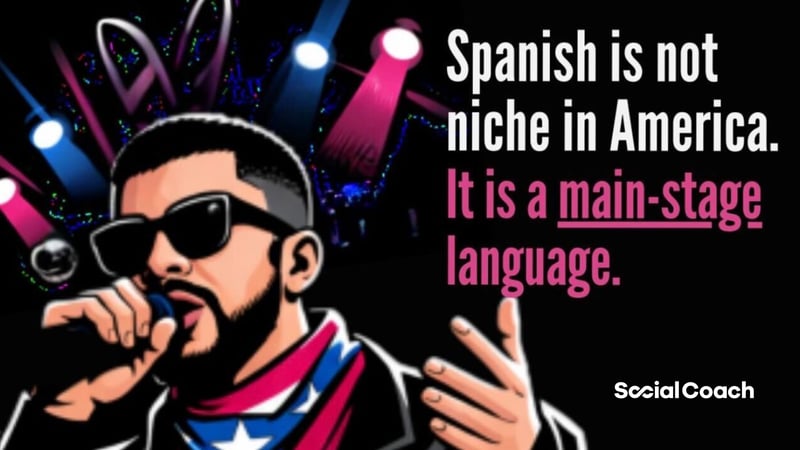
On February 8, 2026, Bad Bunny headlined the Super Bowl halftime show at Levi’s Stadium and performed primarily in Spanish.
Most people saw entertainment.
If you’re a mortgage or real estate marketing leader, you should have seen a signal: Spanish is mainstream, and the housing market is already following. [1]
The tension is real.
Marketing teams want the opportunity.
Compliance teams see risk.
This post is about the third option that actually works: enable Spanish-first outreach with real supervision, consistent language, and modern controls.
Jump to:
The “Bad Bunny” problem | The market shift you can’t ignore | Why compliance hesitates | The real blind spot | What smart teams do next | What regulators are signaling | How SocialCoach makes bilingual social selling safer | FAQs | References
The “Bad Bunny” problem in mortgage marketing
In our industry, “Bad Bunny” has basically become shorthand for the unmonitored variable.
It shows up as:
-
Unmonitored channels: Reels, TikTok, Shorts, Stories (video-first, fast, screen-recordable).
-
Unmonitored language: Spanish, Spanglish, and regional slang that keyword scrapers miss.
-
Unmonitored speed: trends move faster than approvals, policies, and training.
If compliance can’t see, hear, and understand what’s being said, you don’t have supervision. You have vibes.
The market shift you can’t ignore
A few data points that should be on every 2026 planning deck:
-
Hispanic homeownership hit a record 9.8 million households in 2024. [2]
-
Hispanic households added a net 238,000 new homeowners in 2024, the largest increase of any group for the second consecutive year. [2]
-
Urban Institute projects that 70% of net new homeowners from 2020 to 2040 will be Hispanic. [3]
Opinion: if your growth plan does not include Spanish-first trust building, you are choosing to compete harder for less demand.
Why compliance hesitates (and they’re not wrong)
Compliance teams are trying to avoid a two-sided trap:
-
Risk on one side: being absent from communities your peers are serving can create fair lending scrutiny.
-
Risk on the other side: “targeting” communities with inconsistent or sloppy messaging can create serious problems fast.
Regulators have been explicit that fair lending enforcement is modernizing and that patterns in lending and outreach matter.
If you want to see the posture in plain language, start with DOJ’s public updates on the Combating Redlining Initiative. [5]
The real blind spot is Spanish video, not Spanish text
Most monitoring approaches were built for typed English copy.
Today’s risk surface is video:
-
Audio: what was said on camera is what regulators and plaintiffs care about.
-
On-screen text: captions and overlays often carry the riskiest claims.
-
Context: slang and shortcuts can change meaning fast.
-
Velocity: one screen recording can travel forever.
And this matters because Hispanic audiences over-index on the platforms where short-form video wins. Pew reports 62% of Hispanic adults use Instagram (vs 45% of White adults). [4]
What smart teams do next
These moves reduce risk while increasing reach:
-
Stop treating Spanish as a side project. It’s a core growth motion now.
-
Create a “promise map.” What can you say in Spanish on social that stays consistent with what the borrower will experience later?
-
Standardize safe language and disclosures around payments, rates, approvals, closing costs, and timelines.
-
Make Spanish video reviewable. If compliance can’t review video quickly, the whole strategy collapses at scale.
-
Train bilingual LOs on why certain phrases are dangerous. Most issues are education problems, not intent problems.
Language and consistency: what regulators are signaling
A common fear is: “If we start in Spanish, do we have to finish in Spanish?”
The real takeaway is consistency. CFPB has published guidance encouraging institutions to better serve consumers with limited English proficiency (LEP). [6]
CFPB also provides Spanish versions of TRID model and sample forms (Loan Estimate and Closing Disclosure), which can help teams standardize language and reduce confusion. [7]
How SocialCoach makes bilingual social selling safer and scalable
This is exactly why we built SocialCoach for regulated industries.The goal is simple: stay visible without gambling with compliance.
SocialCoach’s Bilingual Compliance Engine makes Spanish content manageable by:
-
Auto-detecting Spanish in video uploads
-
Generating a Spanish transcript plus an English translation side-by-side for faster review
-
Scanning both languages for high-risk trigger phrases before a post goes live
-
Routing content through approvals with archiving and audit trails
-
Centralizing pre-approved Spanish-first scripts, captions, and video prompts so reps don’t freestyle the riskiest topics.
If you want a deeper breakdown of how modern mortgage social compliance actually fails (and what to do about it), this SocialCoach post covers the real risk areas: video, graphics, trigger terms, and scale. [8]
Bottom line
Bad Bunny didn’t “take a risk” by going Spanish on the Super Bowl stage. He reflected reality. [1]Mortgage is being forced into the same reality right now.
The winners won’t be the companies who ban Spanish. They’ll be the companies who implement Spanish with visibility, consistency, and speed.
Want to see what bilingual social supervision looks like in the real world?
Book a SocialCoach demo here.
Frequently Asked Questions
Is Spanish mortgage marketing compliant?
Yes, when it’s supervised, consistent, and does not create a mismatch between marketing claims and the borrower experience. CFPB has guidance for serving LEP consumers. [6]
Do we have to complete the entire mortgage transaction in Spanish if we market in Spanish?
Not automatically, but inconsistency creates risk. If you market in Spanish, build Spanish-capable support at key moments so consumers are not misled.
What’s the biggest compliance risk with Spanish social media content?
Spanish video. Audio plus on-screen text is where risky statements slip through, especially at high posting volume.
Can loan officers post mortgage content in Spanish on Instagram and TikTok?
They can, but only if your organization can review, approve, archive, and supervise it. Without that, it becomes “hope marketing.”
What phrases should LOs avoid in Spanish mortgage content?
Anything that implies certainty or “free” benefits without context, such as: “garantizado,” “dinero gratis,” “aprobación asegurada,” and “sin costos de cierre.”
Why does bilingual content create more risk than English content?
Because most compliance tooling was built for typed English text. Video plus Spanish adds complexity and increases the chance of supervision gaps.
What does LEP mean and why does it matter?
LEP means Limited English Proficiency. Regulators expect clarity and consistency for consumers who do not primarily use English. [6]
How does SocialCoach help with Spanish video compliance?
By making Spanish video reviewable: language detection, dual transcripts, bilingual scanning, and approval workflows with an audit trail.
📚 More from the SocialCoach Blog
References
[1] Pitchfork: Watch Bad Bunny’s Super Bowl LX Halftime Show (Feb 8, 2026) - Read here
[2] NAHREP: Hispanic homeownership record 9.8M; +238k net new homeowners (2024) - Read here
[3] Urban Institute: 70% of net new homeowners projected Hispanic (2020-2040) - Read here
[4] Pew Research Center: Americans’ Social Media Use 2025 (Instagram by race/ethnicity) - Read here
[5] U.S. DOJ: Combating Redlining Initiative milestone update - Read here
[6] CFPB: Statement on serving consumers with Limited English Proficiency (LEP) - Read here
[7] CFPB: TRID Loan Estimate and Closing Disclosure forms (Spanish versions) - Read here
[8] SocialCoach: Mortgage Compliance in 2025 (social media risk) - Read here